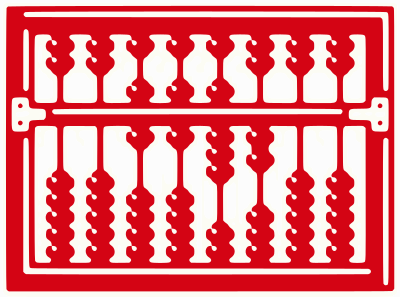
How to use an AbacusDiagram of a typical Chinese abacus set to zero - all heaven beads pushed up and all earth bead pushed down. Heaven beads, each worth 5
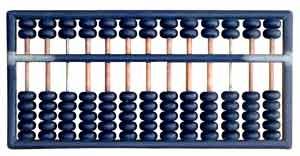
 Earth beads, each worth 1 Try the on-line Abacus The Abacus utilizes a combination of two bases (base-2 and base-5) to represent decimal numbers. It is held horizontally with the smaller deck at the top. Each bead on the top deck has the value 5 and each bead on the lower deck has the value 1. The beads are pushed towards the central crossbar to show numbers. Working from right to left, the first vertical line represents units, the next tens, the next hundreds and so on. So for example to show the number 9, on the first line, one heaven bead (top deck) would be moved down (representing 5 units) and 4 earth beads (bottom deck) would be moved up (each representing 4 units). To show the number 79, in addition to the beads in the first line used to make the number 9, one heaven bead would be moved down and two earth beads would be moved up on the second line, representing 5 tens and 2 tens respectively. Addition on the abacus involves registering the numbers on the beads in the straight-forward left-to-right sequence they are written down in. As long as the digits are placed correctly, and the carry's noted properly, the answer to the operation immediately presents itself right on the abacus. There are 4 approaches to performing additions, each applied to a particular situation. Each of these techniques is explained (!) in tabular form in the sections that follow. Simple AdditionWhen performing the addition 6+2, one would move 1 bead from the upper deck down (value = 5) and one bead from the lower deck up (value = 1); this represents 6. Moving 2 beads from the lower deck (in the same column) up (value = 1 * 2 beads = 2) would complete the operation. The answer is then obtained by reading resultant bead positions. | Given the first number | To add | Move bead(s) |
|---|
| in the lower deck | in the upper deck |
|---|
| 0,1,2,3,4,5,6,7 or 8 | 1 | +1 |
| | 0,1,2,5,6, or 7 | 2 | +2 |
| | 0,1,5 or 6 | 3 | +3 |
| | 0, or 3 | 4 | +4 |
| | 0, 1,2 3, or 4 | 5 |
| +1 | | 0, 1,2 or 3 | 6 | +1 | +1 | | 0, 1 or 2 | 7 | +2 | +1 | | 0 or 1 | 8 | +3 | +1 | | 0 | 9 | +4 | +1 |
An example illustrating the use of the Addition Table, adding 2 and 7: - move down the Given the first number column to a row containing 2 and;
- move down the To add column to a row containing 7: the 7th row, then;
- move across to the Move bead columns and perform the operations specified:
- in the lower deck, count 2 beads;
- in the upper deck, count 1 bead.
- The answer then presents itself on the abacus.
Note: The "+" symbol in the Move bead(s) columns represents moving the bead(s) towards the middle beam; the "-" symbol indicates that the bead(s) should be moved away from the middle beam. Combined Adding-up And Taking OffWhen the original number registered on a rod is smaller than 5, but will become greater than 5 after the addition, one bead from the upper-deck is moved down (added on to the beam) and one or more beads from the lower deck removed from the beam. When a sum greater than 10 occurs on a certain rod, beads are removed from either or both the upper and lower decks and 1 bead is added to the rod directly to the left. Example: When adding 9 (10-1) to 8, one bead from the lower deck is removed (-1) and one bead from the lower deck on the row directly to the left is added (+10). | Given the first number | To add (formula) | Move bead(s) |
|---|
| in the lower deck | in the upper deck |
|---|
| 4 | 1 (+5 -4) | -4 | +1 | | 4 or 3 | 2 (+5 -3) | -3 | +1 | | 4,3 or 2 | 3 (+5 -2) | -2 | +1 | | 4,3,2 or 1 | 4 (+5 -1) | -1 | +1 |
Combined Taking-off And Place AdvancementWhen a sum greater than 10 occurs on a certain rod, beads are removed from either or both the upper and lower decks and 1 bead is added to the rod directly to the left. Example: when adding 9 (10-1) to 8, one bead from the lower deck is removed (-1) and one bead from the lower deck on the row directly to the left is added (+10). | Given the first number | To add (formula) | Move bead(s) |
|---|
| in the lower deck | in the upper deck | lower deck, adjacent (left) column |
|---|
| 9 | 1(-9 +10) | -4 | -1 | +1 | | 8 or 9 | 2 (-8 +10) | -3 | -1 | +1 | | 7,8 or 9 | 3 (-7 +10) | -2 | +1 | +1 | | 6,7,8 or 9 | 4 (-6 +10) | -1 | -1 | +1 | | 5,6,7,8, or 9 | 5 (-5 +10) |
| -1 | +1 | | 4 or 9 | 6 (-4 +10) | -4 |
| +1 | | 3,4,8 or 9 | 7 (-3 +10) | -3 |
| +1 | | 2,3,4,7,8 or 9 | 8 (-2+10) | -2 |
| +1 | | 1,2,3,4,6,7,8 or 9 | 9 (-1+10) | -1 |
| +1 |
Combined Adding-up, Taking-off And Place AdvancementThere are 4 cases when beads are added to the lower-deck, removed from the upper-deck and one bead added to the adjacent rod. Example: When adding 6 (+1-5+10) to 7, one bead is added to the lower-deck, one bead removed from the upper-deck and one bead is added to the left rod (lower-deck). | Given the first number | To add (formula) | Move bead(s) |
|---|
| in the lower deck | in the upper deck | lower deck, adjacent (left) column |
|---|
| 5,6,7 or 8 | 6 (+1 -5 +10) | +1 | -1 | +1 | | 5,6 or 7 | 7 (+2 -5 +10) | +2 | -1 | +1 | | 5 or 6 | 8 (+3 -5 +10) | +3 | -1 | +1 | | 5 | 9 (+4 -5 +10) | +4 | -1 | +1 |
SubtractionSubtraction is performed by first registering the minuend and then subtracting, starting from the left, by removing beads form either or both the lower or upper decks. The final bead-positions represent the answer. Simple Taking-offThis is achieved by simply taking off one or more beads from the lower deck, or sometimes both. Example: When subtracting 7 (represented by -5-2= -7) from 9, remove 1 bead from the upper-deck (-5) and 2 beads from the lower deck (-2). The remaining 2 beads represent the result. | Given the first number | To subtract | Move bead(s) |
|---|
| in the lower deck | in the upper deck |
|---|
| 1,2,3,4,5,6,7 or 8 | 1 | -1 |
| | 2,3,4,7 or 8 | 2 | -2 |
| | 3,4,8 or 9 | 3 | -3 |
| | 4 or 9 | 4 | -4 |
| | 5,6,7,8, or 9 | 5 |
| -1 | | 6,7,8 or 9 | 6 | -1 | -1 | | 7,8 or 9 | 7 | -2 | -1 | | 8 or 9 | 8 | -3 | -1 | | 9 | 9 | -4 | -1 |
Note: The "-" symbol in the Move bead(s) columns represents moving the bead(s) away from the middle beam. Combined Adding-up And Taking OffWhen the number of beads in the lower deck is less than the subtracter (the number being subtracted), one or more beads are added in the lower deck and 1 bead is removed from the upper-deck. Example: When subtracting 4 (+1-5 = -4) from 7 (represented by 1 bead in the upper-deck and 2 beads in the lower deck (less than 4, the subtracter), one bead is added to the lower deck (+1) and 1 bead is removed from the upper-deck (-5) leaving 3 beads, representing the result. | Given the first number | To subtract (formula) | Move bead(s) |
|---|
| in the lower deck | in the upper deck |
|---|
| 5 | 1 (-5 +4) | +4 | -1 | | 5 or 6 | 2 (-5 +3) | +3 | -1 | | 5,6 or 7 | 3 (-5 +2) | +2 | -1 | | 5,6,7 or 8 | 4 (-5 +1) | +1 | -1 |
Note: The "+" symbol in the Move bead(s) columns represents moving the bead(s) towards the middle beam; the "-" symbol indicates that the bead(s) should be moved away from the middle beam. Taking-off From A Rod Of Higher Order And Adding-upWhen a number on a specific rod is smaller than the subtrahend (4 is the subtrahend when performing 13 - 4; note that in the ones column, the 3 is less than the 4) one bead for the order of tens and one bead from the lower-deck has to be taken off, and one bead from the upper-deck is counted. | Given the first number | To subtract | Move bead(s) |
|---|
| lower deck, adjacent (right) column | in the lower deck | in the upper deck |
|---|
| 0 | 1(+9 -10) | -1 | +4 | +1 | | 0 or 1 | 2 (+8 -10) | -1 | +3 | +1 | | 0, 1 or 2 | 3 (+7 -10) | -1 | +2 | +1 | | 0, 1,2 or 9 | 4 (+6 -10) | -1 | +1 | +1 | | 0, 1,2 3, or 4 | 5 (+5 -10) | -1 |
| +1 | | 0 or 5 | 6 (+4 -10) | -1 | +4 |
| | 0,5 or 6 | 7 (+3 -10) | -1 | +3 |
| | 0,1,2,5,6, or 7 | 8 (+2 -10) | -1 | +2 |
| | 0,1,2,3,5,6,7 or 8 | 9 (+1 -10) | -1 | +1 |
|
Combined Taking-off From A Rod Of Higher Order, Adding-up in the Upper-deck and Taking-off in the Lower-DeckThis technique is called for when a number on a specific rod is smaller than the supposed subtrahend (I have no idea what this means), but only in such cases as exemplified by 12 - 6. | Given the first number | To subtract | Move bead(s) |
|---|
| lower deck, adjacent (right) column | in the lower deck | in the upper deck |
|---|
| 1,2,3 or 4 | 6 (-1 +5 -10) | -1 | -1 | +1 | | 2,3 or 4 | 7 (-2 +5 -10) | -1 | -2 | +1 | | 4 or 4 | 8 (-3 +5 -10) | -1 | -3 | +1 | | 4 | 9 (-4 +5 -10) | -1 | -4 | +1 |
More books on abacus:
|